

***
Thou Shalt Not Adulterate: Part 1 by SONIA ELIJAH – soniaelijah.substack.com
In early 2023, Kevin McKernan, R&D lead of the Human Genome Project and genomics expert, stumbled upon a damning discovery whilst analysing vials of Pfizer-BioNTech and Moderna’s mRNA vaccines at his independent laboratory in Boston, MA. The genomicist found billions of fragments of plasmid (bacterial) DNA, present in both the Pfizer/BioNTech and Moderna mRNA vaccines with the (Simian Virus) SV40 cancer promoting genetic sequence, present only in the former.
Firstly, bacterial DNA is not supposed to be in the shots. It is not listed as an ingredient for the Pfizer-BioNTech mRNA product.
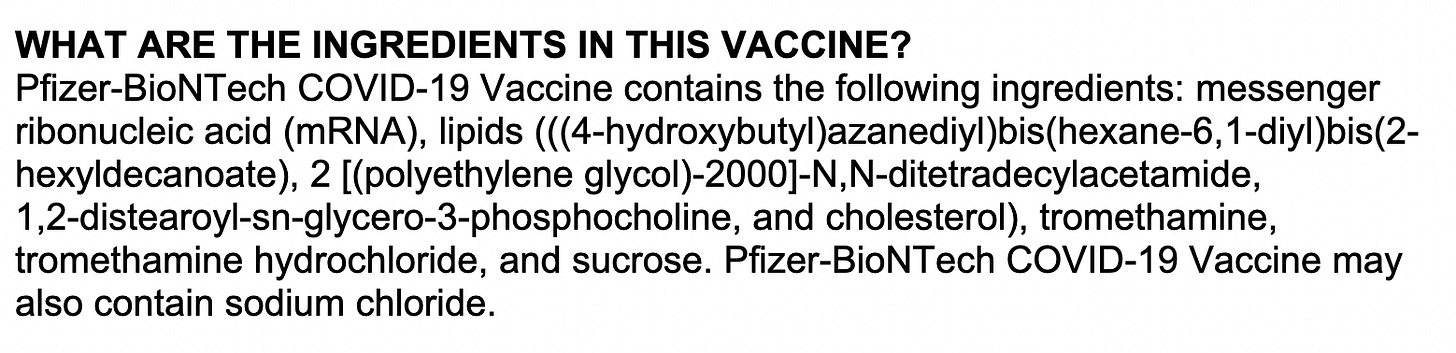
Source: FDA website
It is also absent from the list of ingredients for Moderna’s mRNA product.
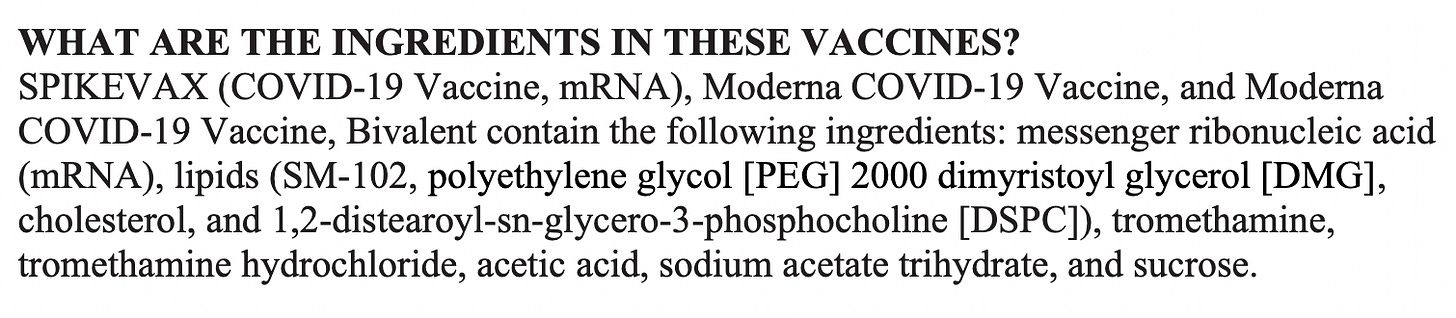
Source: FDA website
The fact that such significant levels (billions to hundreds of billions of fragments of plasmid DNA) are present, vastly exceeding regulatory standards, means both these injectable products are highly adulterated.
What is plasmid DNA? It is a double-stranded, circular DNA molecule that is common to bacteria.
How did it get into the shots? In my interview with Joshua Guetzkow Ph.D., regarding the Pfizer/BioNTech vaccine, he shared how there was a change in the manufacturing process from Process 1 (small scale production) to Process 2 (large scale production). Process 1 utilised a PCR process to amplify the DNA template used in making the mRNA for the vaccine. It also used filtration mechanisms, such as magnetic beads. In order to cut costs and gear up for mass production, Process 2 was initiated, which involved using E. coli bacteria to grow/replicate the DNA that was used as a template for the mRNA. This introduced a lot more contamination into the product.
The contamination scandal does not stop there. McKernan found that in the Pfizer/BioNTech shots, the bacterial DNA contains bioactive gene sequences: SV40 promoter and enhancer.
What is SV40?
According to an article published in PubMed, ‘The polyomavirus simian virus 40 (SV40) is a known oncogenic [tumour causing] DNA virus which induces primary brain and bone cancers, malignant mesothelioma, and lymphomas in laboratory animals.’
Traditionally, SV40 has been used on lab animals to induce the formation of cancer cells (tumour growth).
In 1960, Simian Virus 40 (SV40) was discovered in the oral form of the poliovirus vaccine. It was said to have contaminated up to 30% of the poliovirus vaccines in the US. It was found in the vaccines produced between 1955 -1961, when monkey kidney cell cultures (harbouring Simian Virus) were used in the production process. Lederle, a subsidiary of Wyeth, was the manufacturer at the time. Wyeth was later purchased by Pfizer in 2009.
The difference between SV40 found in the poliovirus vaccine and its presence in the Pfizer-BioNTech shots- is that the complete virus was found in the former. In the latter, two viral components: SV40 enhancer and promoter, were discovered. Enhancers are short nucleotide sequences that enhance the transcription rate in the genome. Promoters are larger nucleotide sequences that initiate the process of transcription.
The work of David Dean, Ph.D. is highly relevant here. His lab at the University of Rochester, ‘studies the mechanisms and applications of plasmid and DNA-binding protein nuclear localization.’
An extract taken from his university lab’s website reads: “We have demonstrated that portions of the 72 bp SV40 enhancer are required for the nuclear entry of plasmid DNA in all eukaryotic cells tested to date; plasmids not containing this sequence remain in the cytoplasm until cell division, whereas plasmids containing the enhancer migrate to the nucleus within several hours.
Dean states very clearly just how integral the presence of the SV40 enhancer is for enabling plasmid DNA to migrate and enter the nucleus of a cell (genome integration).
Other labs replicate the damning findings
McKernan’s findings were later replicated in other independent labs, such as that of the cancer genomics professor at the University of South Carolina, Phillip Buckhaults, Ph.D.
On September 13, Buckhaults testified in front of the South Carolina Senate about his discovery. The screenshot below is taken from one of his slides shown at the hearing.
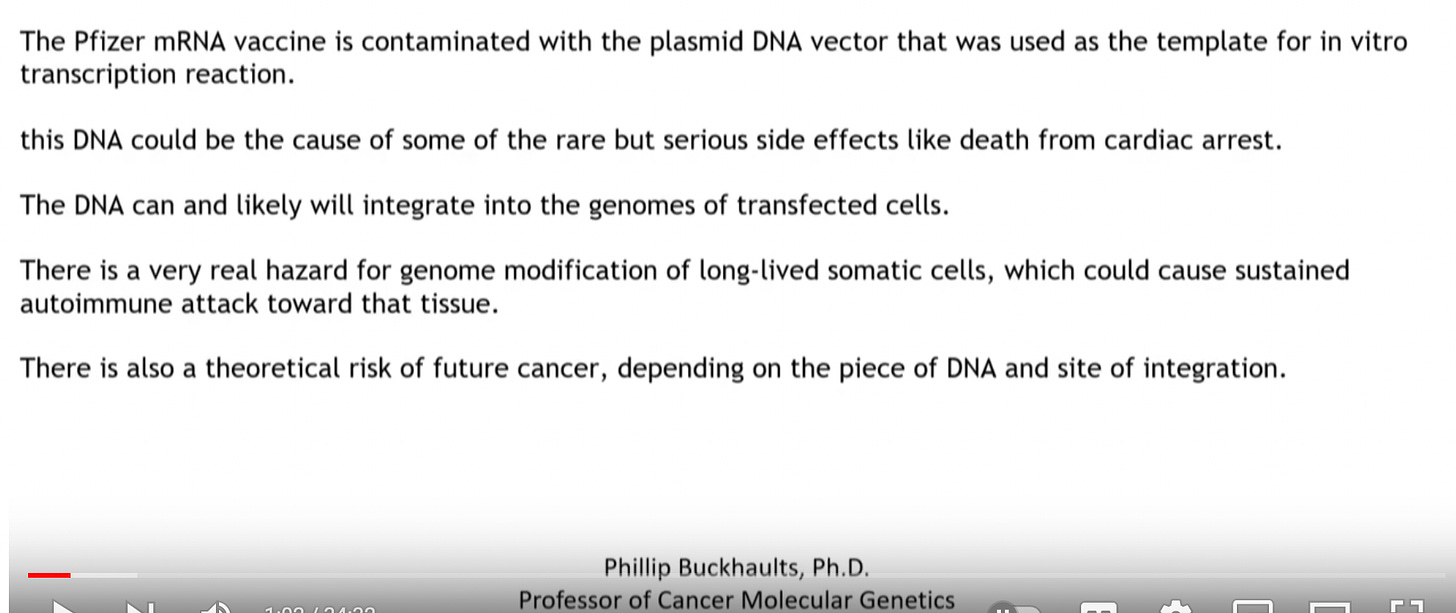
Source: SC Senate Hearing – USC Professor Dr. Phillip Buckhaults
During the hearing, Buckhaults stated:
“I sequenced all the DNA that was in the vaccine and I can see what’s in there and it’s surprising that there’s any DNA in there… I’m alarmed about the possible consequences of this both in terms of human health and biology, but you should be alarmed about the regulatory process that allowed it to get there! So, this DNA in my view, it could be causing some of the rare but serious side effects like death from Cardiac Arrest. There’s a lot of cases now of people having suspicious deaths after the vaccine. It’s hard to prove what caused it…This DNA is a plausible mechanism. This DNA can and likely will integrate into the genomic DNA of cells that got transfected with the vaccine…This is a real hazard for genome modification of long live sematic cells, like stem cells and it could cause theoretically- this is all a theoretical concern, but it’s pretty reasonable, based on solid molecular biology that it could cause a sustained autoimmune tact toward that tissue. It’s also a very real theoretical risk of future cancer in some people, depending on where in the genome this foreign piece of DNA lands.”
On October 9, the World Council for Health organized an urgent expert hearing on the topic of bacterial (plasmid) DNA and genetic sequences in the mRNA vaccines.
The hearing which took place virtually, featured immunologists,
geneticists, specialist physicians and research scientists from the United States, Canada, France, Germany and Australia. The evidence presented led to the panel calling for an “immediate moratorium on these novel genetic ‘vaccines’.”
The higher DNA content, the increase in frequency of SAEs
The panellists included, Kevin McKernan and Jessica Rose, Ph.D, who along with other scientific experts- David Speicher Ph.D, Maria Gutschi and David Wiseman Ph.D., co-authored the study: ‘DNA fragments detected in monovalent and bivalent Pfizer/BioNTech and Moderna modRNA COVID-19 vaccines from Ontario, Canada: Exploratory dose response relationship with serious adverse events.’ Their paper was published on October 19, on the OSF preprint server.
The authors stated: ‘These data demonstrate the presence of billions to hundreds of billions of DNA molecules per dose in these vaccines. Using fluorometry all vaccines exceed the guidelines for residual DNA set by FDA and WHO of 10 ng/dose by 188 – 509-fold.’
They went on to reveal: “we found preliminary evidence of a dose response relationship of the amount of DNA per dose and the frequency of serious adverse events (SAEs). This means that vials with higher doses of DNA content could cause more adverse reactions.
I turned to Jessica Rose Ph.D., computational biologist and co-author of the paper for comment.
“Health Canada recently confirmed the presence of SV40 promoter in the Pfizer products – in fact, this was confirmed on the same day that our paper hit the OSF preprint server. We found residual DNA was found in all 27 (Pfizer and Moderna) vials that we tested – including Adult monovalent XBB.1.5 – at levels that exceed EMA standards, meaning that this is an ongoing and potentially serious problem that warrants an immediate moratorium on these products, and an investigation into the effects of this residual DNA. Some of the potential effects include genomic (and possibly germ-line) integration, that may lead to genomic instability, DNA damage and cancer. We also plotted a dose response curve using serious adverse event reports for the specific vials tested from VAERS (Canadian reports) and this is important because dose response is one of the Bradford Hill criteria for causality. More vials need to be tested, and people need to be tested for integration events as well.”
It is worth watching Rose being interviewed on American Thought Leaders with Jan Jekielek, where she explained:
“If VAERS is a functioning pharmacovigilance database, then why isn’t it being used as such by the owners of the data? Why is it [that] independent scientists like me are having to do this work and bring questions to the table?”
“The onus is not on us to prove that these things aren’t safe. The onus was never on us to do that. This is appalling. The onus is on them, the manufacturers and the regulators, to prove that they are. And they claim that they have done that, but they have not.”
Health Canada & European Medicines Agency confirm presence of plasmid DNA
It is interesting that on the same day the Speicher et al. paper was published, Health Canada confirmed the presence of SV40 enhancer-promoter based on the plasmid DNA sequence in the mRNA vaccines. The Epoch Times broke the story:
The regulator said that after scientists Kevin McKernan and Dr. Phillip J. Buckhaults publicly raised the presence of SV40 enhancers in the vaccines earlier this year, “it was possible for Health Canada to confirm the presence of the enhancer based on the plasmid DNA sequence submitted by Pfizer against the published SV40 enhancer sequence.”
The report went on to quote an email sent by Health Canada to The Epoch Times:
“Health Canada expects sponsors to identify any biologically functional DNA sequences within a plasmid (such as an SV40 enhancer) at the time of submission..Although the full DNA sequence of the Pfizer plasmid was provided at the time of initial filing, the sponsor did not specifically identify the SV40 sequence.”
If Health Canada (and other regulators) had acted as an actual independent regulatory body (free of conflicts of interest) and tested the novel mRNA shots at the vial level- they would have found the contaminants, just how other independent scientists had. Instead, they chose to solely rely on what ‘the sponsor’ (BioNTech) had told them. Then, hide behind the excuse that they were never informed.
The same excuse was touted by the European Medicines Agency (EMA) as stated in their email to The Epoch Times: “While the full DNA sequence of the plasmid starting material was provided in the initial marketing authorization application for Comirnaty, the applicant [BioNTech] did not specifically highlight the SV40 sequence.”
The MHRA’s response
On the heels of Health Canada and the EMA’s admissions, I wrote to the UK’s drug regulator, the MHRA via the website, WhatDoTheyKnow regarding the contaminants found in the Pfizer-BioNTech mRNA vaccine. My inquiry and their response can be read below.
‘Dear Medicines and Healthcare Products Regulatory Agency,
Several independent laboratories around the world have found the presence of billions of fragmented DNA and SV40 enhancer genetic sequence in the Pfizer-BioNTech mRNA COVID-19 vaccine. Health Canada only recently confirmed the presence of SV40 enhancer based on these lab findings.
Please could you inform me:
1. Has the MHRA ever independently tested the Pfizer/BioNTech vaccine at the vial level?
2. Does the MHRA intend to test the Pfizer-BioNTech COVID-19 mRNA vaccine for the presence of fragmented DNA and SV40 enhancer?Yours faithfully,
Sonia Elijah’
On November 9th, I received the MHRA’s response to my inquiry.
‘Dear Sonia Elijah,
Thank you for your request for information dated Friday, October 20, 2023,
where you asked:“Please could you inform me:
1. Has the MHRA ever independently tested the Pfizer/BioNTech vaccine at
the vial level?2. Does the MHRA intend to test the Pfizer-BioNTech COVID-19 mRNA vaccine
for the presence of fragmented DNA and SV40 enhancer?”1. Has the MHRA ever independently tested the Pfizer/BioNTech vaccine at
the vial level?Our response:
In the context of fragmented DNA and SV40 enhancer MHRA has not tested the
Pfizer/BioNTech vaccine at the vial level.Independent laboratory testing of vaccines is carried out by the MHRA’s
Official Medicines Control Laboratory (OMCL) (with a NIBSC certificate
being applied to compliant batches). The independent testing does not
verify the composition of the vaccine, rather it assesses key parameters
that focus on biological quality of the product. Independent assessment
also confirms that the manufacturer has reported on its wide-ranging tests
on the product. Batches of vaccine that meet the specifications in the
approval are certificated allowing the manufacturer to market them in the
UK for use before the batch expiry date. In terms of the Pfizer/BioNTech
vaccines tests conducted at the MHRA include:
Potency/sequence ratio, identity, RNA encapsulation, RNA content, RNA integrityAll vaccine manufacturers must operate to Good Manufacturing Practices and
their facilities are licensed, and are inspected periodically. These
procedures help to ensure that no batches of vaccine that may be
contaminated get released in the UK.2. Does the MHRA intend to test the Pfizer-BioNTech COVID-19 mRNA vaccine
for the presence of fragmented DNA and SV40 enhancer?”Our response:
There are currently no intentions to test the Pfizer-BioNTech COVID-19
mRNA vaccine for the presence of fragmented DNA and SV40 enhancer.We trust that you will find this information of use.’
The MHRA’s response reveals their alarming failings. Firstly, their failure to verify the composition of the vaccine. The MHRA’s independent lab, the OMCL, merely assesses key parameters.
The vaccine testing actually conducted by the MHRA, include: RNA content, RNA integrity and RNA encapsulation. However, this does not instill any confidence for the following reason.
Last year my 2-part investigative report for Trial Site News broke the scandal of the leaked EMA emails, running up to the time when Emergency Use Authorisation was granted by all key regulators. The confidential emails/documents revealed there was a drastic drop in RNA integrity (55%) in the commercial (process 2) batches compared to the clinical trial ones (78%, process 1) of the Pfizer-BioNTech vaccine. All key regulators, including the MHRA, were aware of this fact. The EMA even classified it as a major objection, but the regulators went on to greenlight the novel mRNA injectable product by accepting a lowered standard for RNA integrity- down to 50%. Allowing for up to half the RNA content in the commercial batches of the vaccine to be fragmented (not intact).
The UK regulator’s admission to never testing the mRNA vaccine at the vial level along with their dismissive statement: “There are currently no intentions to test the Pfizer-BioNTech COVID-19 mRNA vaccine for the presence of fragmented DNA and SV40 enhancer” is further evidence of their dereliction of duty in protecting public health.
Part 2 of my report coming soon!
Support indepedent investigative journalism by becoming a paid subscriber or make a one-off contribution so I can continue writing in-depth reports like this.
***

***
Tonight’s musical offering:
 Dispatches from the Asylum