
***
“What’s even worse than a flute? – Two flutes!”
―

Mozart: Piano Concerto No. 14 in E-flat major, K.449
Mozart wrote to his father that among his piano concertos the E-flat major was “one of a quite peculiar kind, composed rather for a small orchestra than for a large one.” In fact, he allowed that this concerto, which includes pairs of oboes and horns in its scoring, could be played as a concerto for piano and strings, without winds. Sometimes one hears it offered as a piano quintet, with one player on each of the string parts, in which guise it comes across as an effective piece of chamber music. It seems clear that Mozart had this practical alteration in mind when he composed the piece, as he kept his wind parts quite in the background, essentially adding sonic reinforcement rather than carrying much thematic material on their own.
THE MUSIC – Another “peculiar” aspect of K.449 is immediately apparent when the piece begins. Mozart rarely set the opening movement of a symphony or concerto in triple time, yet this one is solidly in 3/4; in fact, it is one of only three of his piano concertos to begin in triple meter, the others being the charming F major (K.413/387a) and the hair-raising C minor (K.491). On an emotional scale, this movement falls somewhere between those two. Charm surely inhabits this movement, and at spots the delightful back-and-forth between soloist and orchestra reminds one of nothing so much as an opera buffa. On the other hand, it is a tightly constructed movement, and the concentration of its material renders it quite short. A preponderance of wide intervals, quite a few excursions into the minor mode, and even some bold chromatic modulations add a sense of seriousness and agitation to the proceedings.
The slow movement is restrained and dignified, hushed in character. It boasts beautiful writing for inner voices, particularly for the violas, and the keyboard elaboration grows strikingly elegant.
In 1784 Mozart was embarked on a phase in which he was obsessed with studying counterpoint. In the finale of this concerto we find the fruits of this interest. One might say it is relentlessly contrapuntal (to the delight of those of us who like that sort of thing), beginning with a subject in which second violins play a relatively sustained line beneath the rollicking tune of the first violins. From there we’re off on a through-composed rondo that includes episodes of considerable complexity. The rhythms slow down in what may come across as a rather dreamy section, and a cadence on the dominant seventh chord invites the interpolation of a cadenza, one the interpreter would have to supply, since Mozart provided one only for the first movement. The final pages gallop to the conclusion with an extra infusion of vigor. —James M. Keller – via sfsymphony.org
James M. Keller is Program Annotator of the San Francisco Symphony and New York Philharmonic. His book Chamber Music: A Listener’s Guide, published in 2011 by Oxford University Press, is also available as an e-book and an Oxford paperback.
***
Mozart: Piano Concerto No.14 in E flat Major | Charles Berofsky, NEC Chamber Orchestra
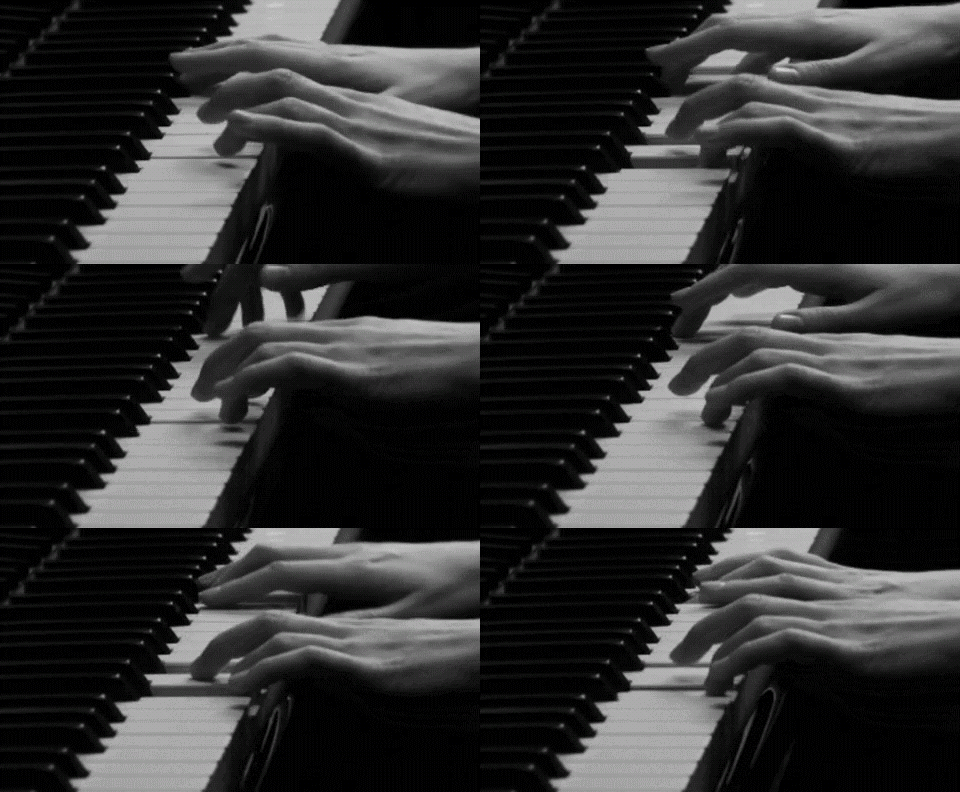
Photo by Dolo Iglesias on Unsplash
 Dispatches from the Asylum